FIND OUT WHERE YOUR
METABOLISM
ACTUALLY STANDS
Most people have a general sense that something is off with their metabolism — that food behaves differently than it used to, that results come slower or not at all, that the effort required keeps increasing while the return keeps shrinking.
This assessment gives that feeling a specific answer.
Four simple physical tests measure your current metabolic engine capacity — the structural muscle base that determines how your body manages energy, responds to food, and whether results hold or reverse. No equipment. No gym. No prior fitness experience required. The whole thing takes about ten minutes.

A STRONG
METABOLIC ENGINE
IS THE DRIVER OF
LASTING BODY CHANGE,
SUSTAINABLE HEALTH
AND FREEDOM TO LIVE

This assessment gives that feeling
a specific answer.
SURVIVAL MODE
Chronic dieting and endless, low-calorie cardio force your body into survival mode. To save energy, your body downregulates your thyroid, drops your body temperature, and burns away your muscle tissue. This leaves you with a "slow," damaged metabolism.
DISUSE ATROPHY
While chronic dieting and improperly used cardio aggressively tears down the metabolic engine, a sedentary lifestyle allows the metabolic engine to shrink and deteriorate to an equivalent degree simply from disuse ("disuse atrophy").
SAME DESTINATION
Both lead to the exact same destination: a low resting metabolic rate, poor glucose tolerance and severe long-term health implications and bodyweight instability.
SAME DESTINATION
These tests your metabolic engine capacity - the structural muscle base within your body that determines how your body uses and stores energy, responds to food, and whether body change results hold or reverse over time.
A NOTE ABOUT WHAT THIS TEST IS ACTUALLY MEASURING:
A person who has been through many dieting cycles—especially when driven by excessive cardio—can deteriorate their structural muscle (the true driver of metabolism). This often forces their muscle mass below 15%, far beneath the 30% to 44% range where a healthy, stable metabolism functions normally. The BUILD FIRST system rebuilds toward that natural, healthy zone. A visibly muscular appearance doesn't begin until approximately 40% to 55%—meaning the entire journey from a damaged metabolism to fully restored health happens in a range that is functionally transformative but visually subtle. This is not a bodybuilding system. It is a metabolic health system.
Your result will tell you where your metabolism stands right now and which part of the BUILD FIRST system is the right starting point for you. Whatever your score is, the system handles it. The only thing the score changes is where you begin

HOW TO TEST YOUR METABOLIC ENGINE
Follow these rules to get an accurate score:
01
The Continuous Rule:
Rest as long as you need between different tests — fully recovering between each one ensures the previous test does not affect your true result. Take as long as you need for your heart rate and energy to return to normal. However, once you begin a test, you cannot pause. You cannot rest at the top of a push-up or pause at the top of a squat. The movement or hold must be continuous until you can no longer continue with good form.
02
The Form Rule:
Use full range of motion throughout. Chest to the floor on push-ups. Hips below knees on squats. A perfectly straight body line on planks. A controlled, honest result that falls short of the threshold is more useful than a forced one that technically meets it.
PHASE 1
THE BASELINE SCREENING
Before measuring your metabolic capacity, this quick physical readiness check confirms your joints, connective tissue, and core stability are ready for the full Metabolic Health Test or if some rebuilding is required first.
Perform each test for as many seconds or reps as possible.
Rest fully between each one.
PLANK
TEST 1

Support your body on your forearms and toes. Elbows directly under your shoulders. Body forming a straight line from head to heels — hips neither sagging toward the floor nor raised toward the ceiling.
Hold until you can no longer maintain the straight line.
Hold as long as you can then record your time in seconds.

WALL SIT
TEST 2
Back flat against a wall, feet walked forward until thighs are parallel to the floor and knees are at a right angle — as if sitting in an invisible chair. Feet flat on the floor, hip-width apart.
Hold until you can no longer maintain the position without pushing through your thighs with your hands.
Hold as long as you can then record your time in seconds.

PUSH-UPS
TEST 3
From your toes if possible, from your knees if not. Hands slightly wider than shoulder-width. Body in a straight line from head to heels or knees. Lower your chest to the floor with control, then push back to the starting position.
Perform as many controlled repetitions as possible without pausing at the top.
Perform as many repetitions as possible, record the number and note whether performed from toes or knees.
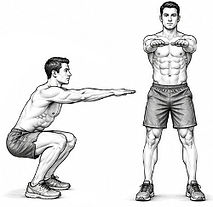
SQUATS
TEST 4
Feet shoulder-width apart, toes slightly outward, chest up, weight through your heels. Lower your hips until your thighs are below parallel — hips below knees. Push through your heels to return to standing.
Perform as many controlled repetitions as possible without pausing at the top.
Perform as many repetitions as possible and record the number
THE BASELINE TARGETS
PLANK
15
SECONDS
WALL SIT
15
SECONDS
PUSH-UPS
3
6
STANDARD
KNEE
SQUATS
10
REPS
WHAT YOUR BASELINE RESULT MEANS:
IF YOU MEET OR EXCEED THE TARGETS
Your joints, connective tissues, and core stability are ready for the standard foundation training schedule within the system. You can jump straight into the main program using standard weights and full-range movements.
If you passed the baseline test with significant margins, the Phase 2 Test below will provide all that is necessary to determine if your metabolism is already healthy and does not require any rebuilding at all.
IF YOU ARE BELOW THE TARGETS
This DOES NOT mean you cannot do the program.
It simply means you will begin at our Reduced Starting Point.
To protect your joints and rebuild safely, you will use bodyweight-only resistance, shortened ranges of motion, and assistive devices (like chairs or elevated surfaces for additional support) until your structural foundation is ready to progress to the full program.
WHERE TO START IN THE SYSTEM ?
If you are arriving at this system from a dieting background.
Or if you have used
programs in the past
that relied on heavy
cardio to force weight
loss, your best path is
to start with the Full
Manual, which gives
an in depth explanation
of why these approaches fail and what damage they do to the metabolic engine in the process alongside all the tools required to rebuild what was lost including illustrated workout diagrams and other information tools.

Alternatively, the Quick
Start Handbook version
provides a lower cost
entry with a more
streamlined explanation
of the principles to get
you going on the purest
form of the system that
you can build upon with the other guides as you need them, if you need them.

If you are arriving from a low or no fitness background.
If you have not dieted in
the past and do not have
any concern about
reversing the lessons that
background taught you,
but you want to improve
your metabolism, increase
your health and fitness
level, or just build more strength, the Strength System Guide will likely be the best starting point for you.
It provides a minimal recap of why common diet and cardio myths cause damage to avoid falling into those pathways, while primarily providing a framework for building a lean and toned body with a strong and stable metabolism.

If you are arriving on behalf of a child or teenager:
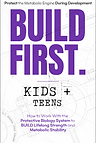
The Kids + Teens Guide
applies the metabolic
engine principles
specifically to childhood
development — the years
when the foundation is
being built for the first time.
It covers age-appropriate movement and strength guidance across all three developmental stages, a practical food reference for parents, and a dedicated chapter on the specific risks of the teen years. Building the engine correctly during development is significantly easier than rebuilding it in adulthood — which is exactly what this assessment may be showing you needs to happen.